Showing posts with label sustainable solution. Show all posts

Thursday, March 12, 2020

Steve K Champions Plan to Use Glass that Would Have Ended Up in Our Landfills


While attending a Mayor and City Council meeting in support of green infrastructure funding, I caught the tail end of their discussion on what to do about our threatened recycling program. Apparently, the city is losing $3 million dollars a year. They discussed ways to save money. One way was to cut down pickups to twice a month. (That change has already been implemented.) They also discussed the high cost of storing glass bottles until they can find a buyer. It was suggested that they throw that glass in the landfill!

NOOOOOOOOOOOOOOO!

I couldn't help but blurt out, "No! Find a use for it!" Not exactly council meeting decorum, I know. But there has got to be a purpose for that glass! In Mexico they used to melt down glass bottles to make glassware. A local artist uses colored glass to decorate her cement candle holders. Since we are running out of sand, couldn't we use glass to replace it in cement structures?

When arriving at the Ward 6 Office for our monthly Sustainable Tucson meeting, my husband pointed out the new sidewalk made out of cement with sand from crushed glass!


When I mentioned the sidewalk to our Council Member Steve Kozachik, he gave me an impromptu demonstration of the glass crusher he had used to make the sand for the cement. He insisted that I try it myself. It was pretty fun.

crushing bottles with labels on them
Steve said that even the cement workers who put in the sidewalk thought it was a crazy idea to use sharp glass.  But any concerns were eased when Steve let me feel for myself how soft and fine the glass sand is.


One of the things I love about Steve K is how responsive he is to his constituents. As much as I'd like to think that my outburst inspired Steve, it was really Val Little who approached him with the idea of using the glass to make sand. She had seen it done in other countries during her travels abroad. Steve got right on it. He surfed the web and found a glass crusher for $6,000 then got the go-ahead from city manager Mike Ortega, who agreed to purchase it for a “pilot program.” 

When I asked Steve why he took on this project, he explained, "We're losing over $3M annually in our recycling program. We have to devise some creative new ways to do the whole reduce/reuse/recycle thing. This is just demonstrating that to city staff."

He told Arizona Daily Star, “What I’m doing back in the garage is really, really (low) retail scale to show the environmental services people that you can scale this up and we can do this on a commercial level. We can create our own secondary market and maybe even make a few bucks."  The sand will be used for monsoon sand bags/mortar mix/filling alley potholes/cover at the landfill/trench lining...anything sand is used for.

I was grateful to have a place to bring the kombucha bottles that were piling up on my back porch. I coudn't bring myself to throw them in the trash when they would just end up in the landfill.  So I brought a few with me when I went to the Sustainable Tucson meeting at Ward 6. 


If you were wondering why the Ward 6 garage smells like a brewery, it is because Steve first approached bars on 4th Avenue to supply him with bottles. He is currently arranging for more drop-off locations around town. In the meantime, you can drop them off in the blue bins in the back parking lot of the Ward 6 office anytime you're in the neighborhood or attending a meeting there. No need to take off the labels, but please help Steve out by removing the plastic and metal lids and dumping out any liquid beforehand.  


What's next? Steve has the city setting up multiple drop off sites around town, buying a commercial scale crusher, and letting Republic Services know that we're not doing business as usual in the recycle world any longer.

So drop by the Ward 6 office anytime with your glass bottles and to thank Steve K! 

The Ward 6 Office is located at 3202 E 1st St, Tucson, AZ (behind the Walgreens on Speedway across from the Loft Cinema.) 

UPDATE: Congrats Steve! The plan worked! On Tuesday, Nov. 17, the City of Tucson Mayor and Council voted to remove glass from the residential and commercial blue barrel program and start reusing it. Glass is no longer be accepted in the blue bins, but instead collected at drop-off sites across the city.

Here's a link to the Glass Reuse Plan with details and drop off spots in Tucson. 

Thursday, February 6, 2020

"Move Tucson" Transportation Master Plan: Your input needed!


I attended the City's transportation event to launch Move Tucson.  The goal is to create a Transportation Master Plan that is good for everyone. Mayor Regina Romero spoke about the importance of getting community input and support. She stressed that this information will be used as guidelines for ACTIONS to be taken by the Mayor and City Council. In addition to community hearings, there will be outreach at the major bus stops and in neighborhoods - to ensure equitable representation.

So, please, take a few minutes to fill out the survey (links below.) 

Gabe Klein, co-founder of Cityfi and co-author of "Start-Up City" was the keynote speaker.

If you missed the meeting, you can watch it here:

 https://vimeopro.com/cityoftucson/tv/video/391064887

Here is a Youtube video with Gabe Klein: . 


The Transportation Master Plan is an important step in mitigating climate change and in making Tucson more sustainable. I personally ride the bus, so I see the need for more stops, later running times and more shade. Right now you can't get everywhere in Tucson. I've heard stories of people getting stranded because they didn't realize that the bus stopped running so early. Imagine being stranded on a cold night. If we are going to get more people to ride the bus instead of driving all over town in one-passenger vehicles, then we need to make it accessible and comfortable. I shared that opinion on the survey below. You can share your thoughts too. 

Move Tucson: Delivering Mobility Choices

The City of Tucson is preparing a city-wide transportation master plan that will create a mobility blueprint for the City's future in a rapidly-changing world. The plan will be innovative, creative, and inclusive. By working together, we can commit ourselves to create a mobility future that works for all of us. How can streets be made safer? How can we expand travel options so more people can walk, bike, or take public transit? How do we improve reliability of travel time, particularly as we grow? Your help is needed in shaping the City's vision and action plan to answer these questions and more. Together, we can create the city we want to be. The outcome of the planning process will be a document that informs the Mayor and Council's decisions in the very near future about policy, resources, and how welcoming and livable our city is to visitors, residents, and business owners.

Interested in helping to shape Tucson's transportation future? Take a short survey and use the city's new interactive mapping app to share what's important to you.


En espanol:https://www.opentownhall.com/portals/310/Issue_8206

UPDATE: On May 14th the City of Tucson hosted town meetings to introduce their mapping app.

This app is so cool. You can click on specific areas and add your own suggestions of what should be included there (like sidewalks, biking trails, green infrastructure, shaded bus stops, safer crosswalks, etc.)

Do you know of an area that needs any of these features? Do you have your own ideas? This is your chance to share them.

Here is a link to the website with the transportation survey and the interactive map app.

https://movetucson.org/


MORE INFORMATION

Tucson wants your input on transportation priorities - Arizona Daily Star, February 10, 2020

Sunday, September 1, 2019

Support Tucson's Green Stormwater Infrastructure Program


I am so excited about the City's Proposed Stormwater Management Program. Installing more Green Stormwater Infrastructure is one of the most impactful actions we can take to make Tucson water independent and secure in the future.  As a citizen advocate, I have attended G.I. planning meetings at the Pima Department of Environmental Quality. I'm so impressed by the incredible the work that the  city and county are doing to implement Green Stormwater infrastructure using guidelines by Watershed Management Group.  To really be sustainable, we need these systems to be built all over town and to be maintained.

The proposed green infrastructure is important for a sustainable future for Tucson.  Please, support the Proposed Stormwater Management Program and Fee by familiarizing yourself with their proposal and providing your feedback in the following survey and showing up at the Mayor and Council Study Session.  

Take this quick survey on the proposed stormwater project here.

UPDATE: 700 people participated in the survey. 80% were positive or extremely positive. There was discussion on extending the survey past the original date - September 4, 2019 (the date of the Mayor and City Council meeting.)

TAKE ACTION 
I encourage you to write your city council member to show your support. 

Find your city council member here:  https://www.tucsonaz.gov/gov/ward-maps

On September 4, 2019.the City of Tucson's Mayor and Council held a study session on a new funding program to support the development and maintenance of green stormwater infrastructure (GSI) across the city to reduce flooding, promote shade trees, along with many other benefits.

Catlow Shipek from WMG shared:

Thanks for your support! We had ~20 supporters in the audience which was acknowledged by the Mayor and Council members.

The motion proposed by Councilmember Durham and amended by Councilmember Romero passed unanimously to direct the city manager to implement the fee review process for a $0.13 per CCF volumetric water use (includes public notice and town halls) will include a fee equity review (comparison of larger commercial to residential) and not be applied to qualified low income customers.

We will be sure to keep folks abreast of developments as it will come back to M&C for formal adoption after the public review process. Here's to a more livable and sustainable Tucson!

More information: 

Scaling up Green Stormwater Infrastructure (GSI) - Watershed Management Group

Thursday, April 25, 2019

Planting Hope


I watched as the scraggly squirrel that lives in our backyard spotted the bright red blossom on our willowy baby pomegranate tree from its perch on our fence.

When Dan planted the durable, heritage pomegranate and fig trees in our greywater basin, he knew we wouldn't be harvesting them anytime soon. It would be a while before the little pomegranate would even be able to bear the weight of its fruit. Watching the scruffy squirrel scamper away with its flower, I realized it will take years until there is enough fruit for all the garden critters, much less us. But I see now that Dan was planting more than just fruit. He was sowing something for future inhabitants - maybe our boys. He was planting hope.

As our country's political landscape heated up, we watched as one of our neighbors built a metal fortress around their yard and posted NO TRESPASSING. Meanwhile, we planted edible moringa along the sidewalk - an invitation for our neighbors to partake. I tended the seeds daily, watching happily as they peeked through their mulchy blanket reaching for rain drops. Dan had planted hope along with the rain.

And I have to admit, I needed that hope to deal with the political climate especially in the face of climate change. It seemed like everyday another environmental protection was being dismantled by our politicians. The effects of climate change were already being felt here in Tucson: the early summer with its rising temperatures and the sporadic, unreliable downpours. Our flourishing moringa was struck by a microburst!


Then the government came out with a report announcing that we had 12 years to do something to offset the worse effects of climate change. I took that as a Call to Action (as did many of my peeps.)  But some people misinterpreted that to mean it was already too late - we had 12 years until the shit hit the fan - so we might as well party and go out with a bang! That's a perfectly reasonable reaction - if there is no hope. But...

THERE IS HOPE.

There are lots of positive actions we can take to improve the outcome.

Let's start with something simple. Start by planting one native tree. Or save one tree.

I know. I know. The general response is, "How can one person make a difference?" The answer is: one person can't.  But nobody said you have to go this alone.

What if we all planted one tree? All of us. Billions of us. And then we planted a second tree...

What if  we worked together as a community to install rainwater harvesting systems in every yard to water our edible forests and gardens? There would be enough water for every home in Tucson! The city and county are already installing these systems all over town. What if we all decided to stop cooking with palm oil to prevent the industry from cutting down more of the rain-forest? Those trees sequester carbon! Sure, there's a lot more we need to do. But this is a start. Imagine how much we could accomplish if we worked together!

Right now we need to plant hope more than ever before.

We can get inspiration from the moringa that got hit by a micro burst...


It's thriving now! Growing from roots deeply planted in hope.


Read more:

For the love of Tucson: Creating a desert oasis to combat climate change

Thursday, November 29, 2018

Lessons from our Recycling Queen - UPDATED March 2022


NOTE:  Recycling Rules change often. If you are unsure, please, check Recycle Coach


Click on What Goes Where, type in item and click on the blues search button

Here's how this blog and Sustainable Tucson's Zero Waste Committee got started: 

After the city's inaccurately named "Recycling 101" event turned out to be more of a budget meeting than a presentation on how to recycle, Sustainable Tucson hosted our own program, "Recycling and Beyond."

On our invitation,  Sherri Ludlam, Environmental Scientist in the Department of Environmental and General Services came to our program and gave us a deep dive into the rules of recycling.  Her.topic was "old and new challenges to Tucson's recycling program." One of the new challenges was that China wouldn't be accepting all of our dirty recycling anymore because of the contamination. Contamination is all the trash that doesn't belong in recycling - including plastic bags that jam up the machines. That same contamination is costing the company contracted to do our recycling truck loads of money. Our bad. Tucsonans put everything from dirty diapers to dead cats to Saguaros in our recycling cans. Sherri reminded us that there are actual people who sort through all that yucky trash. So don't throw in anything that you wouldn't want to find in the recycling can.

Present at both meetings was a bold young woman, Sharia Des Jardins, who gamely explained why you can't recycle freezer boxes. (See reason below). Besides doling out much needed explanations for the new recycling rules, Sharia was there to ensure that conversation covered more than just the profit margin for the recycling company. And Sustainable Tucson had it covered. After an enlightening presentation on the 6 R's  (Refuse Reduce Reuse Repair Recycle Rot) by Zero Waste Maven Alex Kosmider, we had a lively discussion that led to forming a "Zero Plastic Waste" working team.  We are already doing research to repeal the Arizona law prohibiting towns from banning plastic bags. Here is a video of our first meeting.

Since then, Sustainable Tucson's Zero Waste team produced a video called, "No, That Isn't Recyclable" and advocated against single-use plastic bags at the State Legislature. There are exciting new projects happening under committee lead Kevin Greene - including a new Repair Cafe! Find out more and how you can get involved here:


Possible Zero plastics team project? 

 Of course it is still important to safeguard Tucson's recycling program by following the new rules. Toward that end,  I asked Sharia to clarify the recycling rules. I like to think of Sharia as our own "Recycling Queen." 

NOTE: Since this article was written the city now has a glass recycling program program where you can drop off clean glass bottles and jars to be crushed into sand for cement and sand bags. They have also started the Orange Bin Hard to Recycling program. You can place all the other plastics (even plastic bags and Styrofoam!) that weren't previously recyclable into an Orange Hefty bag and drop them off at the orange bins at various locations. 

Queen Sharia Des Jardins shares her own version of "Recycling 101"

I am the first to admit that the info put out by the city is confusing. They say that we can recycle plastic, cardboard, and paper. They show us pretty pictures on a nice blue background but there is much that they actually don’t say that would be helpful. The only way in which we will be able to fulfill our part in the aspects of proper recycling is to fully understand what is and isn’t good. And by that I don’t mean what is and isn’t good for their bottom line. I mean for the planet and for our future.

So, to begin with here are the basics:

Yes – plastics, bottles and containers with numbers 1-2.  Any bottles such as gallon milk jugs, water, soda, etc. should be lightly rinsed – preferably air dried, and the cap put back on before tossing in the bin. This goes for things such as laundry soap bottles too. Please don’t crush them either. 

Yes – aluminum cans from foods– rinse, leave labels on. Also, if you can don’t fully remove the lids. When using a can opener try to open it most of way but not fully so that the lid is still attached. The small, loose metal lids get lost at the sorting facility. 

Yes – soda cans – rinse, air dry. Please don’t crush it makes it harder for them to be sorted as they become smaller. 

Yes- paper – office paper, mailers, brochures, etc. They ask if it is small that you don’t recycle it. It just slips through the rollers at the sorting center. You can always put small slips in an envelope. Just don’t over stuff it or they will pull it off the line wondering what might be in it. No envelopes with plastic bubble on the inside. 

Yes- periodicals, phone books, etc. They are easy to sort and if they haven’t been ripped apart, they should be easy to recycle.

Yes – newspapers, paper bags – Most paper items are recyclable provided they don't contain grease, food residue or a wax coating. Things like glue, tape, staples and envelope windows are ok, but be sure to remove plastic wrappers.

Yes – corrugated cardboard – any of those Amazon or shipping boxes. Don’t worry about the tape unless it covers more than 50% of the box. Just remember to break them down and no need to cut them up in pieces. The bigger the better to fit through the machinery at the sorting facility. 
Yes – paperboard, molded fiberboard - cereal boxes, processed food boxes, egg cartons (not Styrofoam), etc. Again, break them down if you can. 

Yes – ½ gallon milk containers coated in wax, Gable top cartons like the ones used for milk, cream and juice are accepted for recycling. Cartons must be empty and rinsed clean. Can be flattened to conserve space. Plastic caps are ok.

Yes - containers from broth, soups, drink boxes that are foil lined. 
NOT IN BLUE BINS: Glass – bottles, jars, etc. Lightly rinsed and air dried, no lids. (Save water by putting a little water in the bottle and shaking it..) But now you need to bring them to grass drop off spots located around town. 

Ridged plastics such as buckets, storage containers,  landrey baskets, igloo coolers, and chairs are picked up at bulky trash day. (We hope they sort through them and recycle them.) 

No – frozen food boxes! What! They accept waxy milk cartons, but not freezer boxes?! That’s right folks, you thought they were just a box but no, they are paperboard mixed with plastic so that when they are exposed to temperature fluctuations and wetness the boxes won’t collapse. 
No – greasy pizza boxes –  Anything that has come into contact with food or grease is a no go. Worst contamination you can do. If the lid is clean, you can rip it off and recycle it. 

Greasy pizza box - NO! 

No –  dirty bakery boxes, takeout boxes – these have also come into contact with food and grease. If there is a single spot on it it is contaminated. Please put these in the trash not the recycling bin. 

No – loose shredded paper. Do not place shredded paper loose in your recycling container. Place it securely inside a cardboard box, paper bag or clear plastic bag.

Local businesses or organizations accept paper for reuse or recycling. Visit the Tucson Clean & Beautiful Recycling Directory for more information.

Shredded paper in a see through bag so waste management workers can identify it.

No – plastic lids for containers such as yogurt and sour cream. Those lids are actually made of lower grade plastics than the containers themselves. They are also small and less likely to stay on through transport than tops that screw on. Once loose they will fall through the rollers at the sorting facility or gunk them up and cause shutdowns. 


No – plastic films that that are security covers - such as the lift off ones on yogurt containers. Those aren’t even recyclable at the shops. 

No – Styrofoam in recycling cans. The city has no way to recycle this. 


No – compostable containers. These may be from lettuce or other produce/foods. These are not made of plastics that are recyclable. They are made to break down in the landfill or your compost pit, but actually don't break down there either. They take a special composting practice.  

Compostable plastics aren't the same as traditional plastics. They require specialized composting facilities not available to most municipalities. Please place these materials in the trash.

No – plastic bags – absolutely not! They are the bane of recycling centers across the nation. If you must take them from the grocery stores, please return them to a participating store that will recycle them for you. They go to a completely different type of facility to be processed. 

Remember these guys...


What to take to your local grocery stores that accept recycling:  Plastic bags, deflated air pillows from shipping, Tyvek packaging, plastic shipping envelopes, etc. If the plastic had foods in it or has become dirty or sticky, please at least rinse and dry if not clean before recycling. You can contaminate a whole bin while the shop waits for it to be full enough to send off for processing. 

No – trash – this includes anything you know for sure won’t ever have another use. Things like used diapers, kitty litter, doggy doo, broken stuff. Furniture, strollers, etc. 

Please remember that when you put things in your recycling bin that aren’t recyclable someone has to pull those things out. If you wouldn’t want to touch them, please don’t make them do it either. Consider compassionate recycling!

Guest blogger Sharia Des Jardins

Sharia has been doing eco/green coaching professionally for the last 3 years. She managed an eco-friendly home and kitchen store in Portland for many years. While running the T-Rex Museum in Tucson - sustainability, ecology and recycling were part of every group tour for the 6 years she was there. She made sure that every staff member ended their tours with the inevitability of human extinction if we continue in the manner of which we are accustomed to treating the planet. She has been educating friends and family for the last 20 years about what they can do. Sharia also works part time at Jen’s Organic Home and Baby here in Tucson since her return to the city in April 2018 after over a decade of living in the Pacific Northwest.


Check our Sustainable Tucson's music video, No! (That Isn't Recyclable) here.  Consider sharing to increase your positive impact!

Download the city's Recycle Coach on your phone here. 

Wednesday, January 24, 2018

For the Love of Tucson: Creating a Desert Oasis to Combat Climate Change


When I first moved to Tucson, it rained most every day during monsoon season. I remember waiting for it to cool off in the evening so we could take the little ones to the pool. Inevitably we would wait in the car as a storm swept by. Then we would enjoy the most luminous sunsets as we swam - storm clouds catching the brilliant hues of the setting sun. That was the beginning of my love affair with this stunning desert. But it wasn’t until I witnessed the ravages of record heat and sparse rain on our own little monsoon garden that my heart became totally invested in fighting the effects of climate change on our desert town.


I've often pondered how climate change would affect Tucson.  Nobody knows exactly.  But, from what I've learned, climate change often seems to intensify the extreme weather of a particular area. In that case, Tucson would continue to experience rising temperatures, prolonged droughts and more severe floods. That means even more flood damage as storms further erode the banks of hard, dried river beds.

The desert will eventually return to its natural state with or without us. But if we don't stop savaging the earth for profit, Tucson could become a stark, barren desert. If we don't change our ways now, even our iconic saguaros won't be able to survive the scorching heat.


I sometimes wonder what will become of my little house after finally paying it off. If temperatures continue to rise, would my boys still want to live here? Would they even be able to sell the house if they decided to leave? That's one reason I'm dedicated to finding ways to lessen the impact of climate change on our town or at least find ways to live here comfortably.

Anyone who is paying attention knows we need to reduce our dependency on fossil fuels and curb our wasteful consumer lifestyle if we want to stave off climate change. But for Tucson to be more resilient, we need to learn to responsibly use the resources the desert has to offer: the power of the sun, native flora and fauna, and our seasonal rainwater.

We can start by implementing solar energy* to keep our air-conditioners running and planting native shade trees to cool our neighborhoods. But to be really sustainable we need to start living in harmony with the desert. No, I'm not talking about living off the land like the Hohokam before us. I'm not talking about giving up all of our modern conveniences. (Most of them can be adapted or retrofitted to be more environmentally sound.) I'm talking about restoring as much of the desert habitat as possible in an urban environment. I'm envisioning our neighborhoods as desert oases with edible forests of native plants and desert rain gardens with drought tolerant heritage crops. You've probably seen some lush desert landscaping or cool community gardens popping up around town. That's what inspired Dan and I to plant our own edible forest irrigated with rainwater and greywater and to start experimenting with drought tolerant crops. We are working towards food security.


How do we transition Tucson into an urban desert oasis? The first step is embracing the nature of the desert we inhabit. Stop trying to force it into something it's not. Stop bulldozing it and paving it over for perpetual development. Shut off the sprinklers that water those little patches of grass in front of businesses. Sorry, manicured lawns don't belong in the desert - native plants do. We need to rethink our perception of tidy xeriscape landscaping and stop suffocating our native vegetation with plastic and mounds of gravel. Why on earth are we raking up all that great organic matter that could be nourishing our soil and allowing the rainwater to sink in? And all those weeds we "Roundup" can help prevent erosion.

Noooo!

One of the biggest concerns of living in the desert is having a reliable source of water.  Right now Tucson depends on CAP water. A whole coal-powered generating plant was built to run the pumps that push our water 336 miles uphill from the Colorado River. Unfortunately, that source isn't sustainable. As droughts continue, there will be more competition for that diminishing water supply. The river supplies over 40 million people in Arizona, California, Colorado, Nevada, New Mexico, Utah, Wyoming and Mexico as well as a $5 billion-a-year agricultural industry.

The good news is that there is enough annual rainfall to supply every Tucsonan's water needs - if we harvest the storm water. While the city and county work on their own green infrastructure improvements, we can incorporate rainwater harvesting features that keep the water in our yards to irrigate our native landscapes, edible forests and drought tolerant gardens.


Diverting roof water to wood chip mulch covered catchment basins conserves water which helps to restore our aquifers. Those near a river or wash can even help infiltrate water to the aquifer. If you wanna see how it's done, you can tour Watershed Management Group's Living Lab and Learning Center. Using a combination of cisterns and earthworks, WMG harvests enough rainwater (during a regular monsoon season) to meet all of their needs - including irrigating some fruit trees! But more important are their efforts to restore Tucson's aquifers and get our rivers flowing again.

Underground cistern at WMG's living lab

By returning our yards to a more natural state that allows rainwater to sink in, our hope is that it will replenish the Tucson basin and get the rivers flowing year around.

But here is an even greater vision!
 
If we could get everyone on board, we might even be able restore the riparian habitats by the rivers. We could transition to green infrastructure throughout the city. We could all use earthworks to sink in more of the storm water in our yards, schools, churches, business properties, and empty lots. That would slow down the rush of water before it gets to the rivers and washes. That native vegetation would act as a sponge allowing flood waters to sink in! There would be less flood damage. (Extreme weather costs Tucson and Pima Country $9,449,667 a year.)

Restoring the riparian habitat would attract more birds and other wildlife to Tucson. Arizona is already a bird lovers' paradise with ecotourism contributing to our $21.2 billion tourist industry. Imagine Tucson becoming the hub of ecotourism!

     
What is your vision for Tucson?  Would you like to ride your bike along a flowing river surrounded by twisty mesquite? Pick a fig from the orchard in the park? Enjoy the sight of  hummingbirds, butterflies and other pollinators fluttering around desert shrubs in a traffic median? Snack on some yummy edible weeds without worrying about pesticides? Stop by a neighborhood garden stand for some freshly harvested salad fixin's? Wouldn't it be cool if a local farmer grew drought tolerant heritage white wheat and amaranth by the Santa Cruz river to be milled right here in Tucson and baked into healthy bread in Tucson's own native grains bakery?

That's me holding a bag of freshly milled mesquite flour.

 I have a dream. I believe Tucson can thrive in the future if we reduce our dependency on fossil fuels, cut down on waste, restore our desert flora and fauna, and use the desert's resources responsibly.  Instead of polluting our water by mining coal, we can use one of the desert's most abundant resources - the sun! Why not power our vehicles, homes and businesses with solar? We can retrofit our older houses and business buildings to conserve energy and water. We can have neighborhood micro food parks with safe bike and walking paths. We can make Tucson THE ecotourism destination by attracting more birds and wildlife to our urban desert. And all those desert trees sequester carbon!

Brad Lancaster shows how a curb cut lets in street water to irrigate mesquite trees.

We already have a great community working to make Tucson more sustainable: Sustainable Tucson, Feeding Tucson, Community Water Coalition, Sonora Environmental Research Institute, Sonoran Institute, Watershed Management Group, Tucson Water, the 2030 District, Local First, Zero Waste Tucson, UA Compost Cats,  Desert Harvesters, Iskashitaa Refugee Network, Arizona Master Naturalists, The Sierra Club, Tucson Audubon Society, Pima County Master GardenersMission Garden, Community Gardens of TucsonTrees for Tucson, Native Seeds/SEARCH, the Pima County Seed Library, Living Streets Alliance, the U of A, the Desert Museum, and the Community Food Bank's Community Gardens. Several schools like Manzo Elementary and Changemaker High have gardens.

The Pima County Department of Environmental Quality has a manual on green infrastructure. The City of Tucson and Pima County have pledged to fight climate change and even implemented a Green Infrastructure fee. Check out the Mayor's Million Tree Program

Let's work together for a sustainable future for Tucson!

MORE ABOUT GREEN INFRASTRUCTURE IN TUCSON


MORE THINGS YOU CAN DO...

What Kind of Climate Champion Are You? 


Brad Lancaster's Documentary:

Water Harvester: An Invitation to Abundance - Arizona Public Media

Saturday, January 28, 2017

Culture Clash with Our Consumer Teens.


As Dan was supervising snack time in the teen space at the library, he was approached by a teen with potato chip breath.

Teen: You get paid to work at the library? How is that possible? What do you sell at the library? You don't sell anything at the library.

This kid couldn’t wrap his mind around the idea that a service that didn’t make a profit had any value.

I’ve heard similar sentiments from my own jobless teen. He has openly expressed his contempt for Dan wasting time working at the library and volunteering for Code for Tucson or Watershed Management Group – when he could be out making real money as an engineer. That money, of course, could go towards a car to drive him to his weekly Magic tournaments so he won’t be forced to endure our sustainable form of transportation (gasp!) - the city bus.

I’m beginning to think that this is a thing - or so I gleaned from a conversation I had with a couple of teenage boys at the Women’s March in Tucson. These cavalier young men felt comfortable in this mass of mothers to boldly hold up signs that read, “Build the Wall” and “Gays for Trump.” The little dickens got what they asked for when they got schooled (or in teen speak, nagged) by somebody’s mother, namely me. I asked them if they cared about the environment at all. They shrugged, “No.” When I asked them why they supported Trump, their unequivocal answer was “more jobs to pay for new cellphones and Xboxes.” (Dan said that there was a group of teens following them laughing, so they may have just been trying to get a rise out of us. Well, they got it!)

Listening to teens with Trump signs at the Women's March in Tucson.

What’s with the youth today? Why doesn’t our son share our values about giving back to the community and living more sustainably? These teens have literally bought into their role as consumers in our capitalistic society. But haven’t we, as a country, been programmed to value the pursuit of profit above all else – even profit without accountability? While Dan and I have pledged to boycott Walmart because they exploit child labor abroad and don't pay their U.S. workers a living wage, our local Walmart just expanded.

What are we really getting out of our “profit first” consumerism? Are we even getting a good value?

Let’s look at some things our American teens consume...

Clothes:

Americans spend billions on the latest clothing fads. What do we get for our money? Disposable clothes designed to fall apart after a few washes, probably sewn in a foreign sweat shop, possibly by child slaves. Poisons from the dyes are dumped into our waterways. After a few months, these clothes are good for nothing but rags or to take up space in a landfill. I may be showing my age, but sometimes I get a yen for the good ol’ days when you could buy classic, quality clothes that would be worth repairing.


Bottled Drinks:

Look around at the store. We have shelves full of every kind of drink you can imagine. Yummy! But to get the plastic to make all those bottles, oil is pumped miles and miles through leaky pipelines. Oh, you drink water? How much do we really pay for that 89 cent bottle of water? Nestle is taking water that has been pumped 322 miles uphill (a whole coal-fired power plant was built to power the pumps that has already used up all the water in the Hopi and Navajo’s aquifer). All of those bottles then become a part of five massive plastic “islands” in the ocean. 


Food:

In America, we can get any food we want, when we want it! But really…how fresh and healthy is our food? To have a longer shelf life, our food is filled with chemicals and preservatives. To improve the flavor they add addictive sugar to everything. (But at least that has spawned the diet industry...) Even our produce is transported from neighboring states, Mexico, or shipped across the ocean putting CO2 and other toxins in the air. Rain-forests are cleared to raise beef cattle. We Americans just love our weekly specials. But what is the human cost of those bargains? The people who harvest our foods live in squalor and can’t even afford the foods they pick. (For just one cent more per pound, the pickers could double their income to a living wage.) Meanwhile, millions of tons of food is thrown into landfills because it is damaged, unattractive or there is just too much of it (lowering profit.) Luckily, there are some good people working on preventing food waste

Fast Food:

Every parent laments how much junk food their teen consumes. But fast food fits perfectly into our busy lives. At home it’s frozen convenience items (about as flavorful as the disposable boxes they come in.) It may be cheap, but you get very little actual nutrition for your money. Fast food restaurants do supply two or three low paying jobs for each of their underpaid workers. To maximize profit, companies fight a raise in the minimum wage. But fast food does contribute to heart disease and diabetes – creating higher paying healthcare jobs. Unfortunately, minimum wage workers can’t afford healthcare insurance. This means choosing between bringing their kid to the doctor or having dinner. If it's a real medical emergency, there will be no money left for their mortgage payments. We can step over them on the street - where they have no value in this society since they are no longer consumers.


So what do I say to our consumer teens?

We may not have all the latest gadgets, the biggest screen TV or even a car. But we are blessed to have a comfortable little house. Dan’s library job leaves him time for his passions: teaching robotics and computer programming, building community, and getting outside to enjoy our beautiful desert landscape while installing rainwater harvesting features. It actually makes us feel good (gasp!) to carry our own delicious drinks in our cool reusable water bottles - knowing we aren’t adding to the plastic island. We enjoy treasure hunting for quirky clothes at the thrift store. Tending our little garden and cycling to work gives us a chance to enjoy our beautiful Tucson weather. And nothing beats the excitement of seeing our little rainwater harvesting projects working!

Hey!
Even my teens can appreciate the yummy home cooked meals and fresh baked bread that Dan has time to make - not to mention the time he has to spend with them.

And just look at these smiles... Aren't they worth it? 


Tuesday, July 19, 2016

Celebrating Imperfection: A Zero-Waste Journey

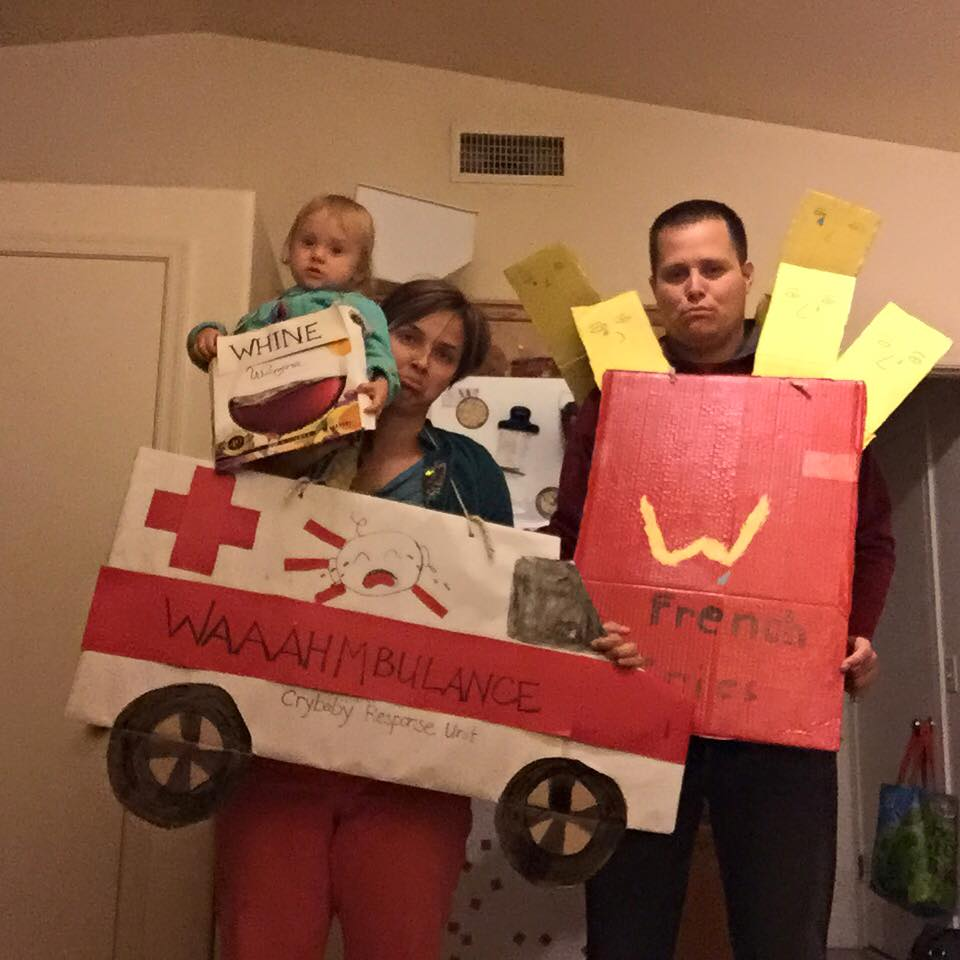
A waaahmbulance, whine, and french cries.

by guest blogger Alex Kosmider

I was a bit floored by Jana's invitation to write as a guest blogger about my experiences with zero waste.  So thanks for the opportunity to share what I know.

Ain't she cute?
My mother’s influence has made aspects of Zero Waste a part of my life for as long as I can remember. She gardens, cans, sews, nags employers to implement recycling programs, and hands out reusable bags at the grocery store. She was president of the PTA at my elementary school and even painted a mural in our cafeteria of children holding hands around Planet Earth (I know--cutest thing ever, right?) She planted my favorite tree at the time (a willow) and organized a school-wide grounds improvement day. When I left the family nest, I already had a sense that nature, and coexisting within it, was important and needed to be protected. (Thanks for that, mom!)
However, my appreciation for considerately sharing our habitat with other species went hand-in-hand with a realization that we humans are seriously screwing with our natural resources. Two books really made me feel the sheer weight of the problem of waste: The Story of Stuff by Annie Leonard and Zero Waste Home by Bea Johnson. I had always viscerally cringed at single-use plastic and full plates of food thrown away back when I worked as a buffet server. When I moved to Japan, I observed that packaging was abundant yet kept tidily out of sight for the sake of a harmonious environment. I saw the adorable, ice cream truck-like Japanese trash compactors bring trash and recycling “away,” but I knew that “away” doesn’t exist: I mentally envisioned the truckloads dumping into the ground or (in the case of Japan,) lining up at incinerators to send up billows of toxic smoke. Since then, my interest in a zero-waste lifestyle has bordered on obsession. I feel empowered to take control of my own consumption at home. Thus the seeds of my environmental evangelism were planted.
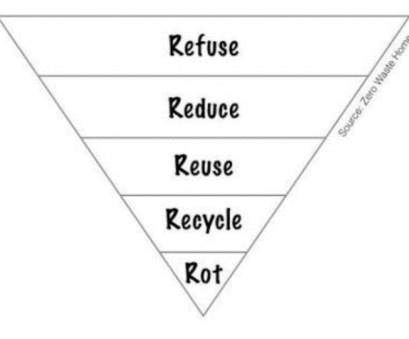
With this knowledge, I try to live in a way that is as zero-waste as I can muster. My relationship with "stuff" is informed strongly by the principles Bea Johnson outlines in her book, which shares some simply-put advice on how to reduce the physical waste in your home  I add this mini-lecture only because this knowledge blew my mind a bit: she adds two more steps to the traditional model of "Reduce, Reuse, Recycle" that takes the reduction of waste to the next level.
Notice that the "new" concept of refusal is the first and largest part of the pyramid. Kind of a big shift in thinking, huh? Refusal to accept unnecessary packaging or to buy new things (within reason, of course) guides how I use, repair, and re-purpose the things I already own before I look to purchase anything else. And in a country where companies spend literally hundreds of billions of dollars trying to get you TO buy new things, refusal requires some skills that big businesses have spent the last couple of decades getting us to forget, like how to mend, repair, re-purpose, buy used or make do. And with two dogs and a toddler (with one on the way), there are pretty much endless opportunities around my home for repair and reuse. Here are some tricks I've picked up along the way, as well as some local Tucson resources for the tools and know-how.
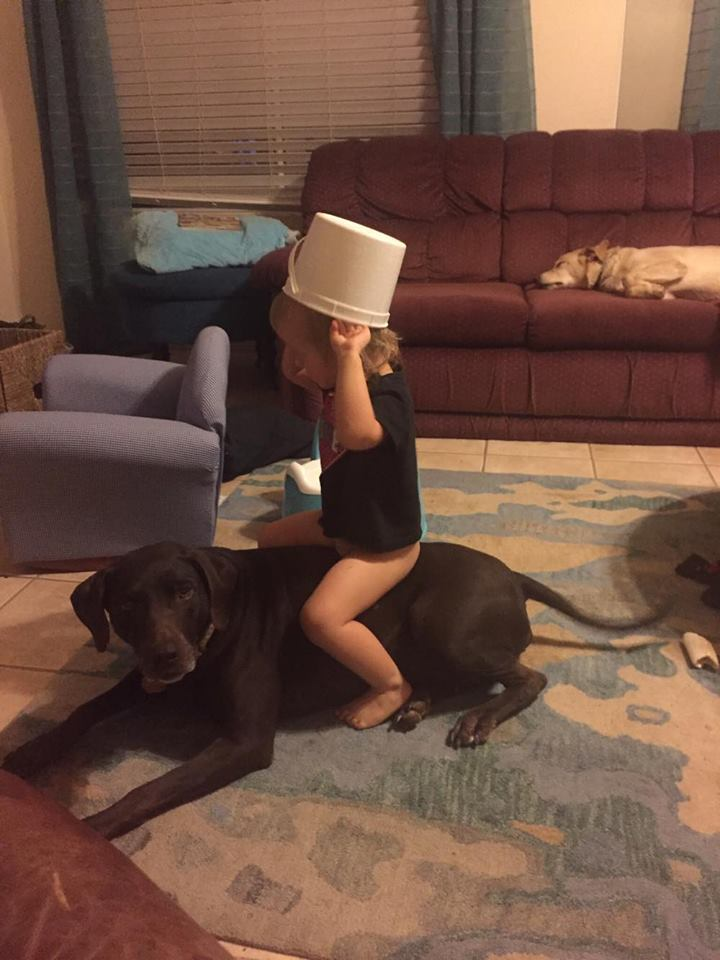
My daughter atop Lily, her noble scissor-toothed steed, complete with repurposed bucket as battle helmet.
Mending: Lily is my wonderful, sweet, neurotic 70-pound lapdog with a nervous habit of scissor-chewing through fabrics. So I have a bit more experience with this than I ever wanted to have. However, I like that each mend you make gives you the potential to leave your creative mark on that item. Suddenly there is a story behind that article of clothing that the visible mend commemorates. Frankly, though, I derive the most satisfaction from the fact that mending my clothes helps me not to contribute to the problem of the 21 BILLION POUNDS of post-consumer textile waste that Americans produce annually. There are a few techniques I rely on extensively like patching and embroidery.
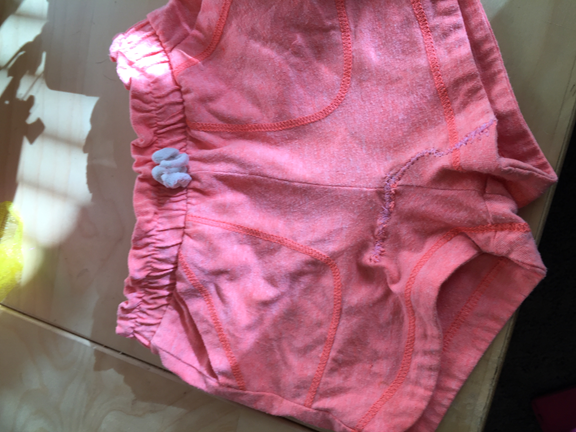
Aren't these jeans pretty? You don't have to turn your mangled denim jeans into a pond landscape, though. It'd be great to say I did that one myself; my repair jobs are much more mundane, like these shorts, masticated by my dog.
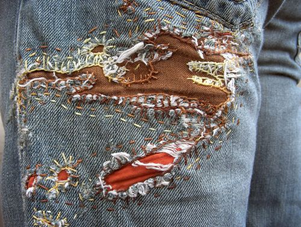
Mending art!
Frankenshorts
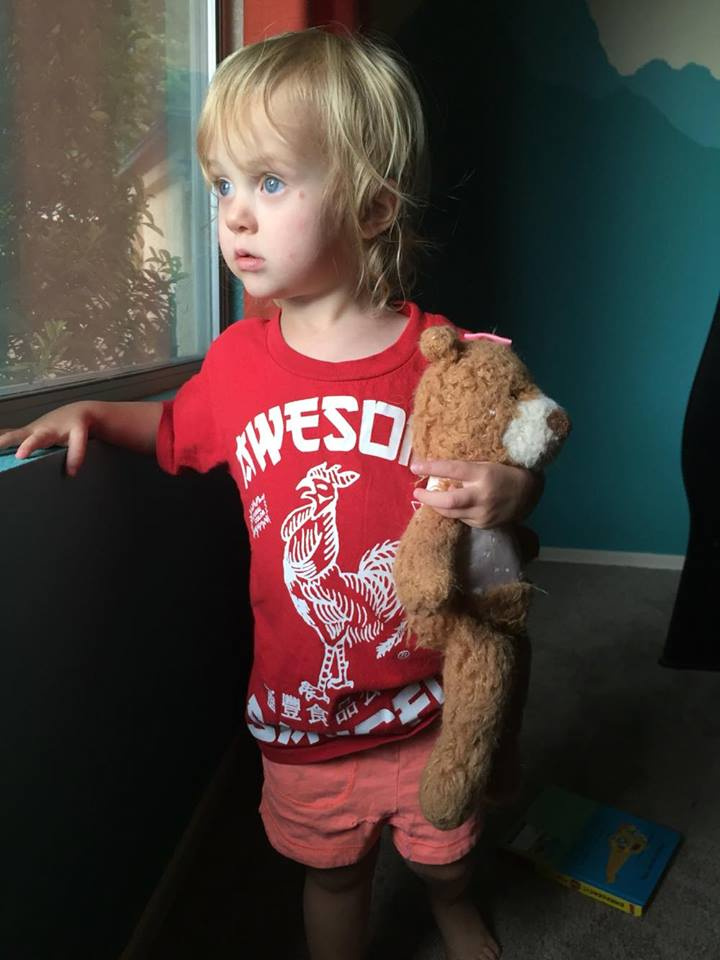
I affectionately refer to them as Frankenshorts, as the mend is clearly visible, since I had no matching thread available.  But don't they just scream, "Let me tell you the story of my shorts!?" Either way, they work just as well as other shorts to enable the important work of toddlers.
Like caring for teddy bears and watching out for “dun-doh!” (thunder!)

A pretty painless mend saved these pajamas, which don't look bad, if you ask me!
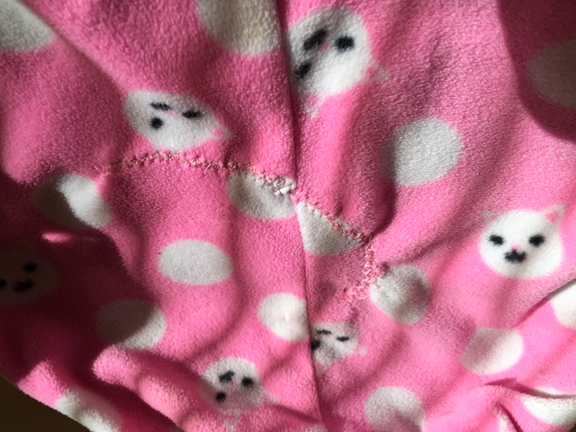
Practically unnoticeable, right? Just say, "yes."

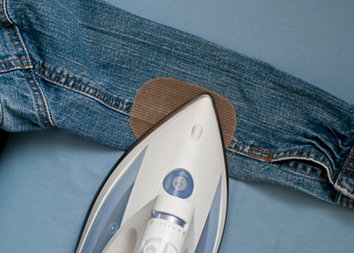
Scared of needles or just don't want to deal with it? Iron-on patches often do the trick.  Admittedly I like the idea of not having to rely on an iron and adhesives, but the process can be quick and painless, and sometimes patches just look cool.
Iron-on patches are so hot right now.
I also found in repairing a sofa (also caused by dog chewing) a great stitch that sews up tears quite well.
If your piece has a hole rather than a tear, darning apparently works, but I have never hand-darned.  Instead, I have used a technique similar to that used in this video where a denim mender sews over the same area over and over in many directions until new fabric is created. I was able to prolong the life of my husband's favorite jeans using this method.  The jeans have since passed (may they rest in peace), but I will say that it gives one the satisfaction (I suspect) of a surgeon stitching up a gaping wound, minus the years of schooling and the terrible stress! Or you could just patch it.
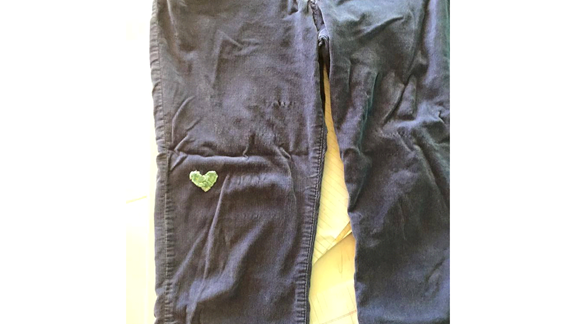
I literally "heart" my pants
Don't feel confident enough to do it yourself? Search for a local tailor or seamstress. I have gotten a zipper repaired on a pair of favorite athletic skorts. Fifteen dollars and a lot of procrastination later, I have a functioning wardrobe staple again!
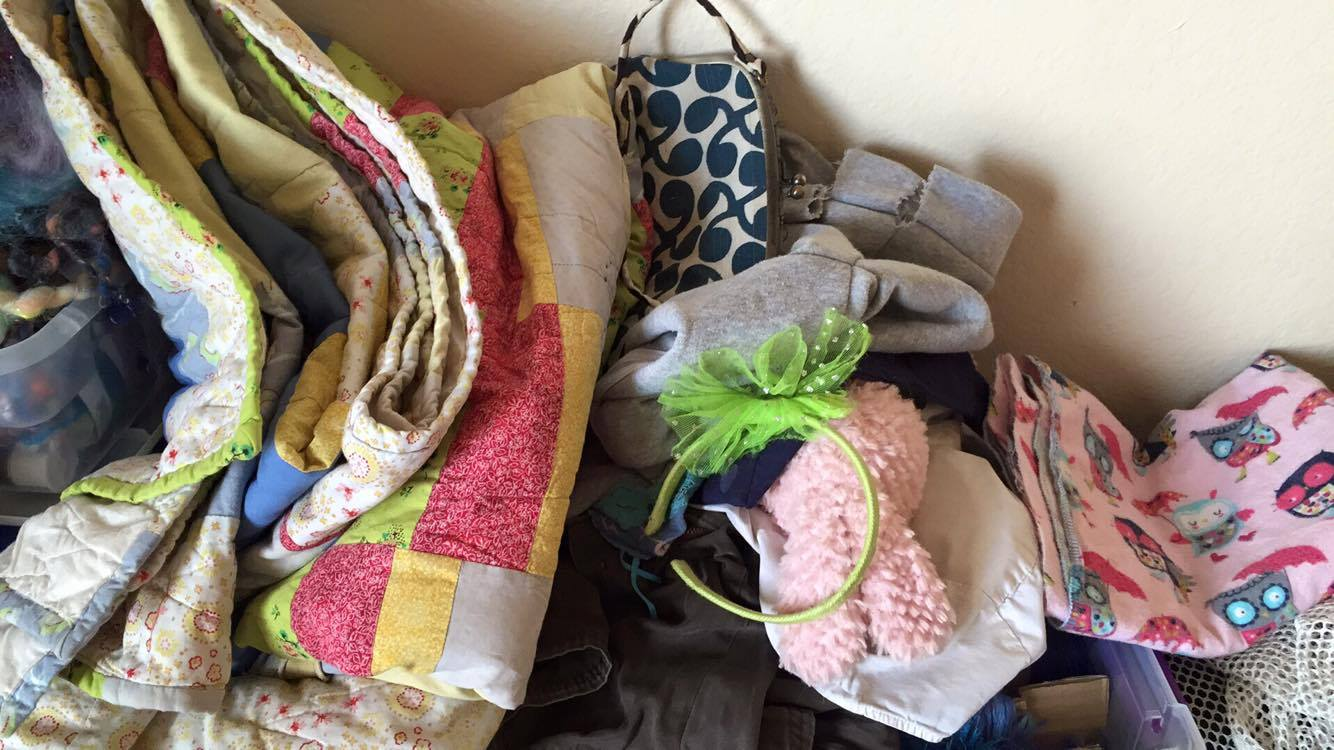
Speaking of procrastination, here is my "to mend" pile. Perhaps I should take my own advice and bring some of these items to a tailor. However, being quite stingy with my money, I am willing to let non-essential stuff sit in a pile until I find the time to repair it. Sustainable? Kind of...
“Tomorrow, tomorrow, I love ya, tomorrow. You let me pro-craaa-stiiii-naaate!” Pretty sure that’s how the song goes.
Unfortunately, sometimes the damage is not worth repairing and the clothing becomes raw fabric for any number of purposes. This is where I must tread the fine line between sensible storage and packrattery. Much smaller pieces become household rags. Goodwill also accepts rags and other fabric scraps to be recycled (so I trust, anyway) just bring a bag labeled "RAGS."
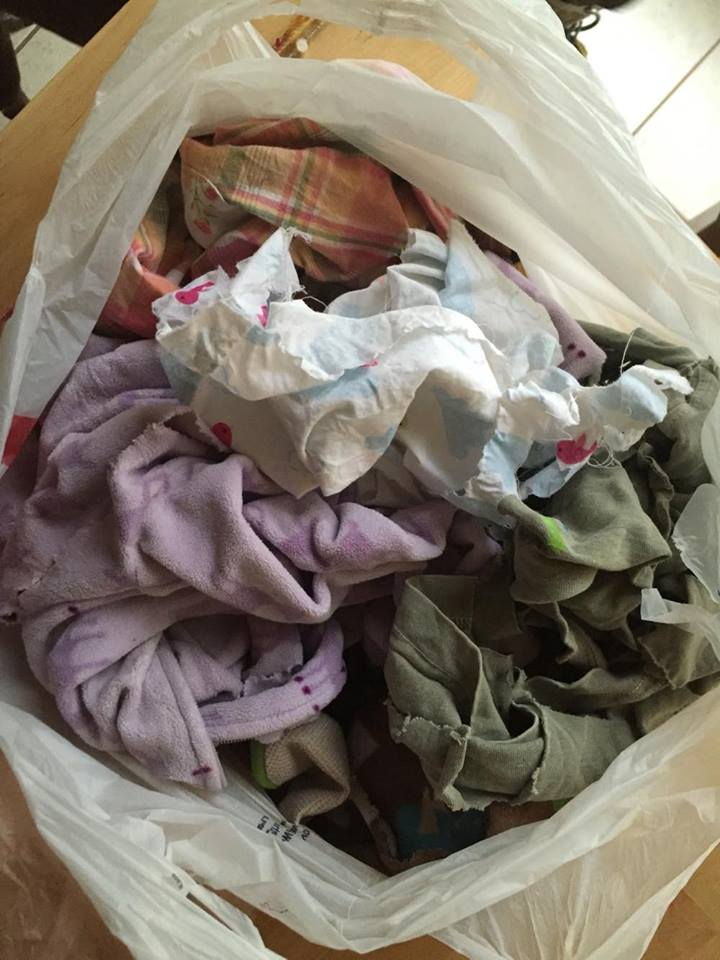
My Goodwill Rag Bag. Seriously, what's up with my dog?
Repair, non-clothing: This topic can be a bit tricky, and is a bit more out of my comfort zone than clothing-related maladies. Unfortunately, due to wasteful production practices such as planned obsolecence--where companies specifically make an item flimsy or easily breakable so consumers must buy another--many things we have in our homes are specifically designed to be difficult or impossible to repair, or not even worth the cost of repairing. But that doesn't mean we shouldn't try.
Frankly, the greatest extent of my own successful repairs involve Gorilla Glue and broken ceramics--hat tip to my friend, a potter, for this gold nugget of wisdom. I have to say that Gorilla Glue is fantastic at bonding ceramics together, so much so that they are watertight and therefore remain in everyday use. I have saved bowls, mugs, a salt shaker, some IKEA furniture that I apparently don't know how to assemble correctly, among other things.
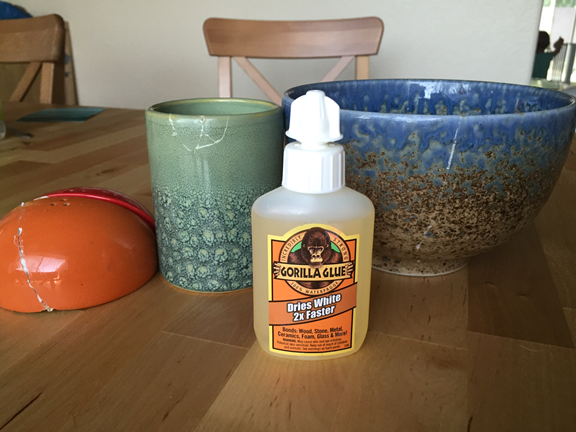
Gorilla Glue is amazing.
I would love to start a repair cafe where volunteers can offer their fixing expertise. But I am excited to try the closest thing we have here in Tucson - Xerocraft. It is a workshop that offers classes on woodworking, sewing, laser cutting, welding, and other stuff that is helpful in repairing.
What other repair resources do you know of in Tucson?


Reuse: Here are some things that I've done to reuse--ideas that you could...ahem...reuse.

Bulky and Brush pickup days. (This could probably be a blog post all on its own.) Essentially there is always somewhere in Tucson where households put their Brush and Bulky trash out for collection. Yes, I’m talking dumpster diving, minus the dumpster. If you have a friend with a truck (or another appropriately-sized vehicle that you don't mind getting a little dirty), this is such a gold mine for large items that can be reused with a bit of creativity.

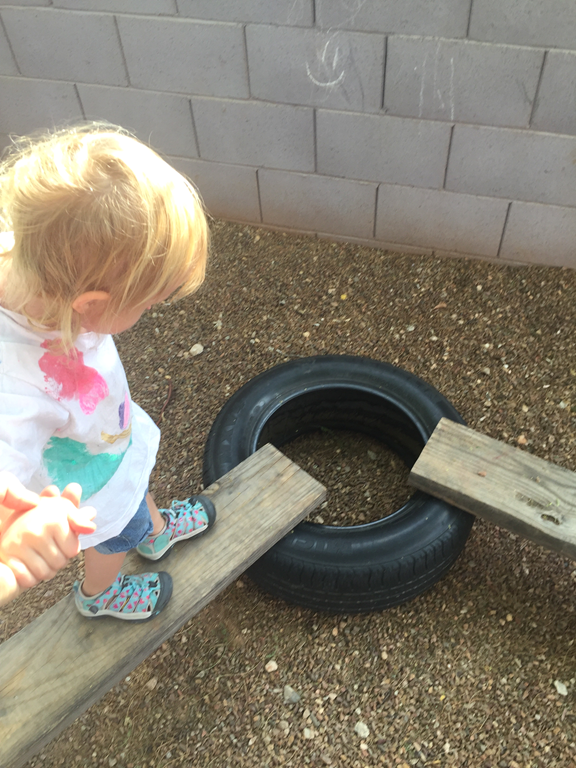
While some of the things that people throw away are genuinely toxic and probably shouldn't have existed in the first place, as Jim Carrey says as The Grinch, "One man's toxic sludge is another man's potpourri." My sentiments exactly. So the last time we had this pickup in our neighborhood, I scored some tires, wood, and stumps for my toddler to play with in our backyard.
Wood boards and a few tires make a fun natural-ish play area for the toddler.
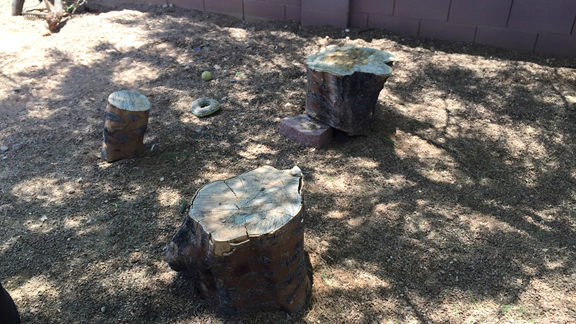


I worked up the guts to ask the homeowner if they would help me load these freshly-cut Palo Verde stumps from her Brush and Bulky pile, as the heavier ones easily exceeded 100 pounds.
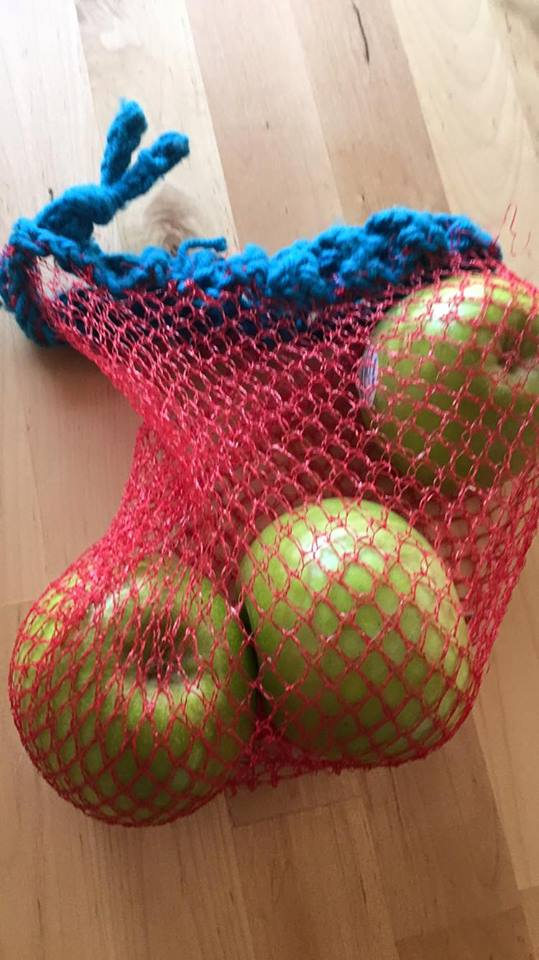
This is my bag, baby.
Mesh produce bags. While I try to use my homemade produce/bulk bags whenever possible for groceries, I occasionally succumb to the pull of non-local mandarin oranges that come in plastic mesh bags, which I prefer to a plastic produce bag because many are quite durable and can be made into reusable mesh produce bags  Cool, right? Of course, it does require some knowledge of crochet, but it's easy enough to learn.
"Make do": I have yet to determine what exactly makes certain objects such coveted targets for my dogs, but many things in my home have been diminished to a still-useful-but-not-pretty state via mastication. If the object is still usable, why not continue to use it?
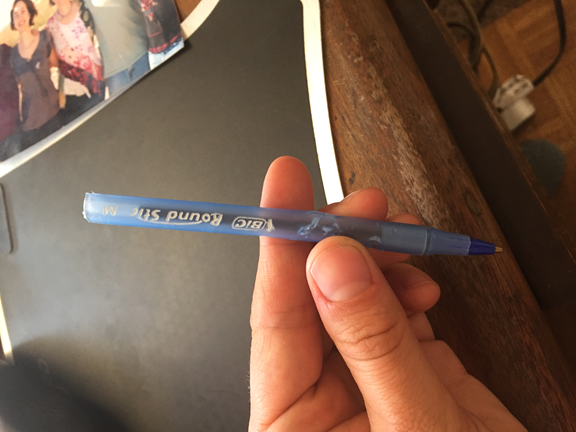
See this half-pen? The important half is still intact, so a quick snip with the scissors prolonged its life. Of course, in an ideal world I would own a refillable fountain pen, but I would hate for my pets to ruin that investment.

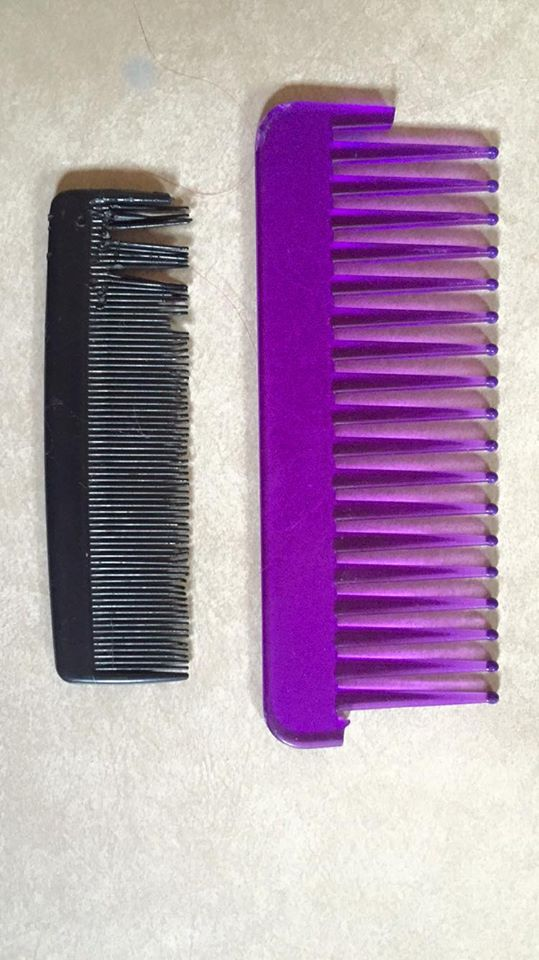
And no one really sees these combs, so they remain in our rotation. Perhaps that is obvious, but a Zero-Waste lifestyle embraces this kind of imperfection. A few missing teeth is just a sign that you stand for something, right?
We'll call her nubs.

These suggestions are in no way exhaustive. In fact, they are just the beginning! I am several years into my journey, and frankly I still have a long way to go. But I'm glad to see the desire to mend, repair and reuse (rather than buying new) getting a 21st-century makeover, thanks to people like you who made it all the way through this post!
If you are interested in discussing more ways you can reduce your contribution to the landfill, please, visit my Facebook group, Zero Waste Tucson. We welcome your ideas, questions, and discussion related to reducing packaging, food, and water waste.

Feel free to reuse this post!